Discount Tire (DT)
Helping employees stay with the customer, not the desktop terminal
Role
Associate Product Designer
Timeline
1.5 years
Scale
1,150+ stores, nationwide

01 / Overview
Discount Tire employees could only do key customer tasks, like tire checks and add-on sales, at a desktop terminal. That meant walking away from the customer, and it added 15-20 minutes to each interaction. There was no mobile experience at all.
02 / My Role
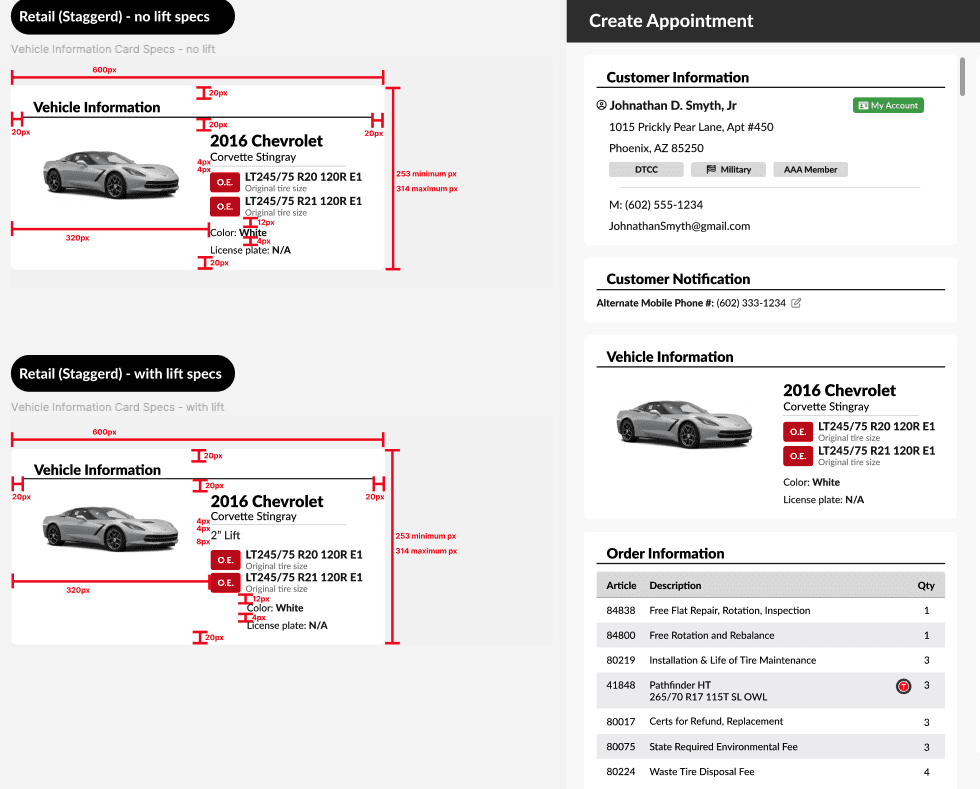
I designed the first mobile experience for in-store employees and refreshed the desktop designs it mirrors. I worked across 4 workflows in Project Vision, from wireframes to high-fidelity prototypes and usability testing.
03 / Challenges & Proposed Solutions
Challenges
No mobile experience existed
Employees switching between devices
Glare, gloves, and quick glances mid-conversation
7 siloed workstreams and legacy files
Proposed Solutions
A mobile app built from scratch for Zebra TC77 handhelds
Mobile flows that mirror desktop, so tasks don’t need relearning
Larger text and touch targets, higher contrast, icons, and global navigation
One consistent component system, with legacy files converted to Figma
04 / Key decision
Let users drill in, not dig through
Corporate feedback only goes so far, so I advocated for moderated, in-person testing on the actual Zebra devices. I ran 10 sessions with store employees, which let us read body language and ask follow-up questions in real time. They surfaced navigation problems in low signal and readability problems in direct sunlight, and those findings shaped the final accessibility spec.

05 / Results & impact

06 / Reflection & next steps
1. Test where the work happens.
Sunlight and low signal never showed up in a conference room. Testing in store, on the real hardware, changed the design.
2. Build the system while you build the product.
Connecting screens across all seven workstreams exposed missing screens and mismatched components early, so the mobile build became the pattern everyone else aligned to.